
2025–2026 U.S. Undergraduate Admissions Cycle Data: An Analysis of Five Major Trends

As decisions from a number of universities, including Duke University, are being released one after another, the 2025–2026 U.S. undergraduate admissions cycle has basically entered its final stage. Although the waitlists at some schools are still in operation and the final yield rates have not yet become fully clear, based on publicly released admissions results, official data, and policy changes, we can already make a relatively clear preliminary assessment of this admissions cycle.
2025–2026 Admissions Data for the Top 50 Universities in the United States
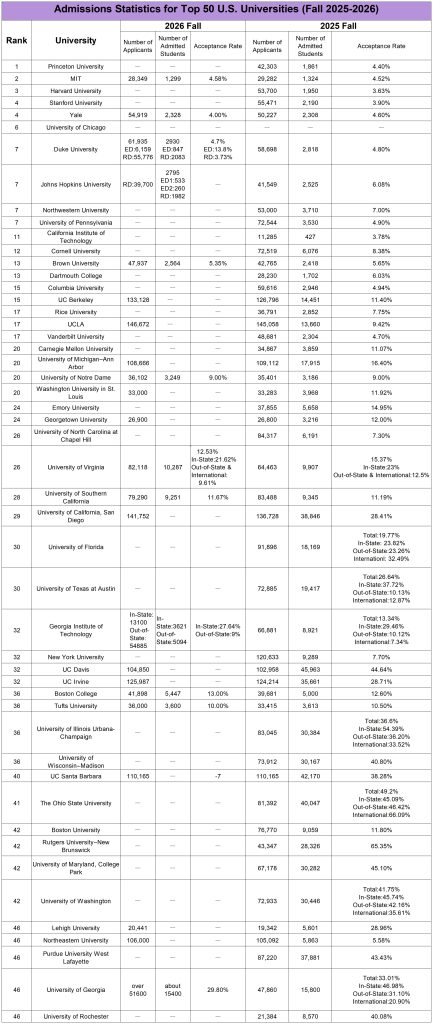
Judging from the data and results, this year’s changes are not simply a matter of admissions becoming “more competitive.” What is truly worth paying attention to is that the underlying logic of competition in U.S. college admissions is undergoing a deeper restructuring.
The following five trends may be the most important signals for parents and students to pay attention to in this admissions cycle.
1.Application Volume Is Rising, While Admissions Screening Is Becoming More Selective
According to data released by the Common App, as of March 1, 2026, both the number of applicants and the total number of applications in this admissions cycle continued to grow compared with the previous cycle. However, if we look more closely at the segmented data, an important change becomes clear: among the most selective institutions with admission rates below 25%, the rate of application growth was actually relatively slower than that of other tiers.
This shows that while top universities are certainly still very difficult to get into, their low admission rates are no longer driven solely by the single factor of “more and more applicants.” In the past few years, many people’s understanding of the difficulty of admission to top universities has often remained at the level of “an expanding applicant pool leading to lower and lower admission rates.” But today, the real competition at top institutions is increasingly reflected in the fact that schools are conducting more refined, more in-depth, and higher-dimensional screening among a large number of outstanding applicants.
In other words, the challenge is no longer simply that “there are more applicants,” but that “there are too many equally outstanding applicants, and schools need to use more complex standards to differentiate among them.”
This also means that, in future admissions, the decisive factor may no longer be only “whether you have reached the threshold of excellence,” but rather “whether you possess greater readability and selectability within the same tier of applicants.”
2.The Early Application Advantage Continues, and Strategy Shapes Outcomes
In this admissions cycle, many schools continued to maintain a pattern in which early application admission rates were significantly higher than overall admission rates. For example, Yale reported an overall admission rate of 4.0% for the Class of 2030, while the admission rate in the early application round was approximately 10.9%. Vanderbilt also released ED I and ED II data for the Class of 2030, showing that the size of its early application pool continued to expand. Information officially disclosed by Penn also shows that 51% of the previous incoming class came from ED.
Behind these figures lies a very practical admissions logic: at highly sought-after institutions, schools are increasingly relying on the early application round to secure the students they most want in advance.
For schools, the value of early application is not only to complete part of the admissions work ahead of time, but also to manage yield more steadily, identify applicants with stronger demonstrated interest, and improve admissions efficiency. For students, this means that the application round itself has already become part of the competitive strategy.
Many families still understand the application process as “prepare the materials well, then make a push in the RD round,” but the reality is that, by today, the true competition often begins to separate applicants before RD even starts. Some students do not lose because of background or ability, but because of timing.
Therefore, in future application planning, “when to apply, in which round to apply, and how to allocate early application opportunities” should not be regarded as technical details, but as core strategy.
If the test-optional policies of the past few years reshaped the traditional understanding of the role standardized test scores play in U.S. college admissions, then starting in 2024, top institutions began gradually restoring their emphasis on hard academic indicators. By the 2025–2026 admissions cycle, this trend had become even more evident.
In this admissions cycle, Harvard required the submission of SAT or ACT scores; Brown returned to a test-required policy; Cornell announced that, beginning in Fall 2026, it will once again require first-year applicants to submit SAT/ACT scores; Yale, meanwhile, adopted a test-flexible policy, requiring applicants to submit one type of score from the ACT, SAT, AP, or IB. At the same time, Princeton currently continues to maintain a test-optional policy.
This shows that policies among top institutions are not entirely uniform, but the overall direction is already very clear: schools are once again placing greater value on indicators that allow for cross-comparison of students’ academic ability.
The logic behind this is not difficult to understand. In an environment where the number of applicants continues to rise, transcripts are becoming increasingly polished, and activity résumés are growing ever more impressive, admissions officers face a practical question: how can they more effectively assess the academic preparedness of students from different schools, different curricular systems, and different regions?
Under these circumstances, externally verifiable indicators such as GPA, course rigor, standardized test scores, class rank, and AP/IB/A-Level results will once again play a more important role.
Therefore, for future applicants, the biggest misconception may be continuing to evaluate today’s admissions environment through the assumptions of several years ago. Today’s application landscape is becoming increasingly less receptive to attempts to compensate for insufficient academic credibility through activity packaging alone or storytelling alone.
In the end, whether an applicant is truly competitive still comes back to a more fundamental question: is your academic ability sufficiently stable, sufficiently clear, and sufficiently well supported by evidence?
4.Competition in Applicant Profiles Has Intensified, and Positioning Matters More Than Ever
In the understanding of many parents, the most important thing in applying to top universities is to be “well-rounded and excellent”: high scores, many activities, strong awards, and an impressive résumé. But judging from the results of this admissions cycle, being merely “excellent” is increasingly no longer enough.
What admissions officers truly want to see today is not simply a student who has “done a little of everything,” but rather an applicant with a clear direction, internal coherence, credible motivation, and future potential for growth.
This can be seen very clearly in the official language and essay prompts of many schools.
For example, in its official welcome message to the Class of 2030, Penn emphasizes not only academic strength, but also impact, engagement, and students’ sustained investment in their interests and actions. Cornell and many other schools’ supplemental essays in recent years have also increasingly emphasized the coherence among “why you chose this direction,” “what you have done,” and “how you will continue to develop.”
What this reflects, in fact, is a further upgrading of admissions evaluation standards. Schools are not ignoring grades, nor are they ignoring activities; rather, they are increasingly concerned with whether those grades and activities can, together, tell a convincing story.
Why is it that some students appear to have backgrounds that are “strong in every way,” yet end up with disappointing results? Why do some students, whose number of activities may not seem especially remarkable on the surface, still receive extremely impressive admissions outcomes?
The core difference often lies not in “how much they have done,” but in “whether there is a central thread.”
In other words, what will truly be competitive in future admissions is not piled-up excellence, but structured excellence. It is not “I can do everything,” but rather “who I am, why I have taken this path, and where I am going next.”
5.Cost Matters More Than Ever, and Choices Shape Outcomes
In the past, when discussing college applications, the question most families cared about was “Can the student get in?” But today, after receiving admissions offers, more and more families are seriously comparing a different question: “After getting in, is it actually worth attending?”
In this admissions cycle, more and more schools are using stronger financial aid policies to attract outstanding students, making the consideration of “cost and return” increasingly important.
For example, Yale’s new aid policy has expanded further and has become more favorable even to middle- and upper-middle-income families: families with annual incomes below $200,000 may qualify for tuition-free attendance, and those below $100,000 may have the full cost of attendance covered. Penn had also previously announced an expansion of its financial aid commitment to middle-class families.
The impact of this kind of policy change on family decision-making is actually very direct. In the current economic environment, choosing a college is no longer simply a question of “prestige.” It is increasingly becoming a comprehensive judgment involving school resources, opportunities in the intended major, geographic location, career outcomes, and the family’s actual financial burden.
From the admissions side, this in turn also affects schools’ yield management and waitlist strategies. As more families begin to compare cost-effectiveness, financial support, and long-term return in a rational way, schools must make more refined predictions about who is more likely to enroll, who is more likely to decline, and which students may require financial aid in order to improve conversion.
This means that future college admissions will no longer be only a competition for admission itself, but also a complex interplay among admission, financial considerations, and final enrollment decisions. For families, a truly mature application strategy cannot focus only on “reaching higher”; it must also think ahead about “fit” and “follow-through.”
Conclusion
If I had to summarize the 2025–2026 U.S. undergraduate admissions cycle in one sentence, I believe the most accurate judgment would not simply be that “it has become more difficult,” but rather that the underlying logic of admissions competition is being restructured.
Therefore, future admissions outcomes will increasingly not be determined by any single background factor. What truly creates distance between applicants is often whether a student has sufficiently clear academic preparation, a sufficiently mature application timeline, and sufficiently accurate strategic judgment. In other words, U.S. undergraduate admissions today are no longer just about “how outstanding you are,” but also about whether you clearly understand the kind of competition you are in.